



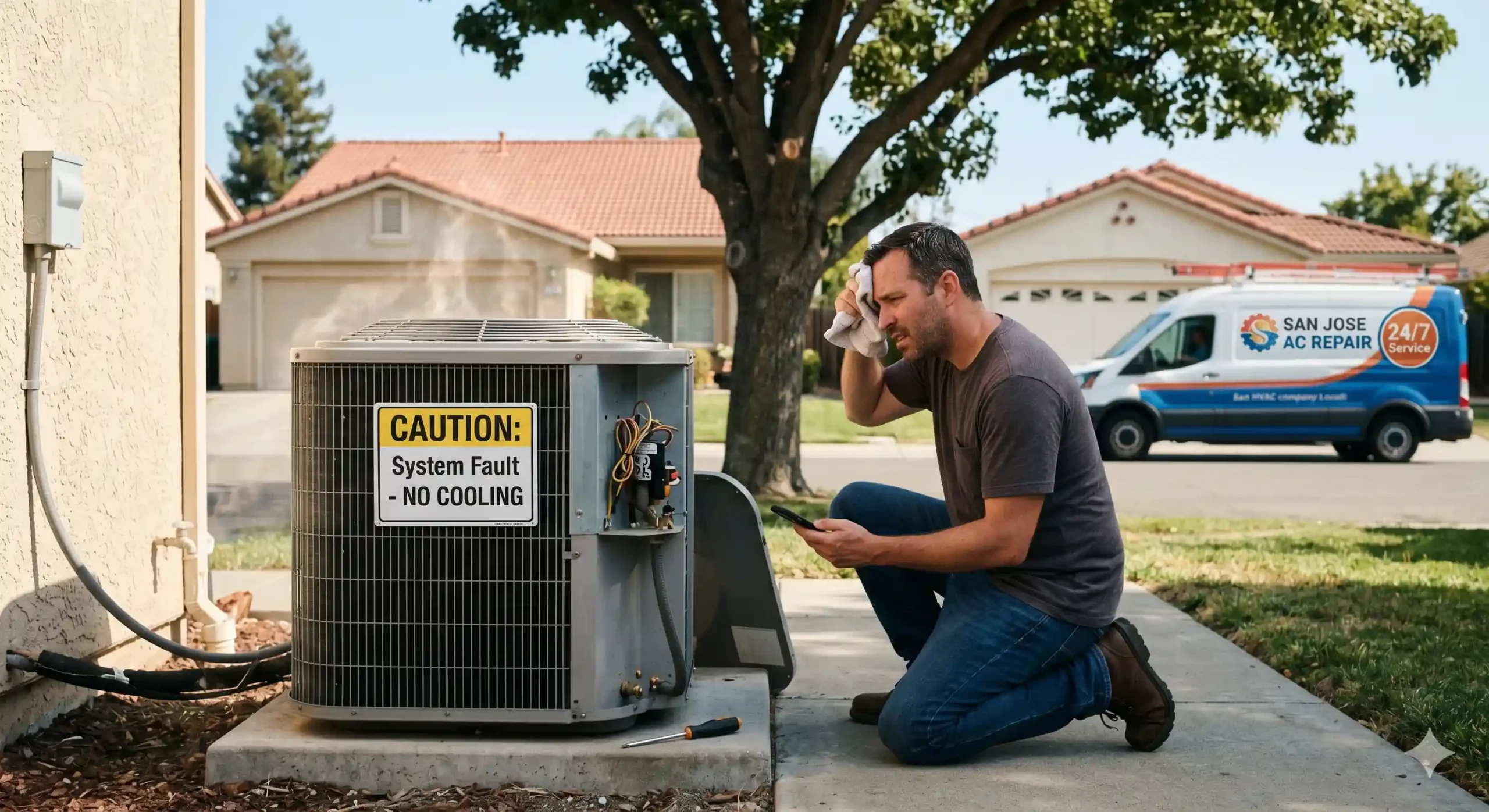
It’s 93°F in San Jose and your air conditioner is running—but your home feels more like a sauna than a sanctuary. Few things are more frustrating during a South Bay heatwave. The good news? Some of the most common reasons your AC isn’t cooling your house are things you can fix yourself in minutes. Others require a licensed Santa Clara County HVAC technician.
This guide walks you through seven of the most likely culprits, from a dirty air filter to low refrigerant levels, so you can stop sweating and start troubleshooting—right now.
Quick Check: Is Your AC Actually Broken or Just Misconfigured?
Before you call for HVAC emergency service, take two minutes to rule out the simplest explanations. Many San Jose homeowners discover their AC isn’t broken at all—it’s just set up wrong.
Thermostat Settings: The “Fan On” vs. “Auto” Mistake
Check your smart thermostat settings right now. If the fan is set to “On” instead of “Auto,” the blower runs continuously—even when the system isn’t actively cooling. The result is room-temperature air blowing through your vents, which feels warm on a hot day. Switch it to “Auto” and your system will only circulate air when the compressor is actually running. Also, confirm your target temperature is set lower than the current indoor reading.
Power Issues: Checking the Circuit Breaker and Outdoor Disconnect Switch
A circuit breaker tripped by a power surge or overload can cut power to your outdoor condenser unit while leaving your indoor air handler running. Head to your electrical panel and look for a breaker labeled “AC” or “HVAC” that’s in the middle position—that’s a tripped breaker. Reset it once. If it trips again immediately, stop and call a professional, as repeated tripping signals a deeper electrical problem. Also check the outdoor disconnect switch near your condenser unit to make sure it hasn’t been accidentally switched off.
7 Common Reasons Your AC Isn’t Cooling Your San Jose Home
If the quick checks didn’t solve your problem, one of these seven issues is likely to blame. Work through them in order—they’re ranked from easiest DIY fix to problems that need a professional.
1. Extremely Dirty Air Filter
San Jose sits in a valley surrounded by dry hills. During summer, particulate matter from the California landscape—plus wildfire smoke on Spare the Air days—load up your air filter fast. A clogged filter chokes the airflow your system needs to function. Without adequate airflow, your AC can’t pull warm air across the evaporator coil, so it can’t cool your home no matter how long it runs.
Fix: Pull your filter out and hold it up to a light. If you can’t see light through it, replace it immediately. For most San Jose homes, filters should be checked monthly during summer and replaced every 60 to 90 days.
2. Frozen Evaporator Coil
Counterintuitively, your AC can freeze itself into ineffectiveness. When airflow is restricted—often because of a dirty air filter or low refrigerant levels—the evaporator coil gets too cold and ice forms on it. Once frozen, no air can pass through, and cool air stops flowing from your vents.
Fix: Turn your system off entirely and run the fan on “Auto” or shut everything down to let the coil thaw—this can take 2 to 24 hours. Check and replace your filter, then restart. If it freezes again, you likely have a refrigerant leak and need a licensed technician.
3. Clogged Condenser Unit
Your outdoor condenser unit needs open airflow to release heat from your home to the outside. During San Jose’s dry season, leaves, dust, and debris collect on and inside the unit’s fins and housing. If the condenser is blocked, it can’t expel heat efficiently—so your refrigerant can’t cool down, and your whole system underperforms.
Fix: Turn off the power to the unit at the outdoor disconnect switch. Remove large debris by hand. Use a garden hose on a gentle setting to spray the fins from the inside out. Clear at least two feet of space around the unit. Never use a pressure washer—it bends the fins and causes additional damage.
4. Low Refrigerant (The “Freon” Myth)
Many homeowners assume their AC just needs a refrigerant “top-off” the way a car needs oil. That’s not how it works. Refrigerant operates in a closed loop and doesn’t get consumed. If your system is low on refrigerant, it has a leak—and simply adding more without fixing the leak is a temporary band-aid that violates EPA regulations.
Symptoms of low refrigerant include: warm air from vents, ice on the refrigerant lines, a hissing or bubbling sound near the unit, and significantly longer run times. This repair always requires a licensed HVAC technician who can legally handle refrigerant, locate the leak, repair it, and recharge the system to the correct level.
5. Faulty Capacitor or Contactors
This is the single most common electrical failure our technicians encounter during San Jose’s summer heat spikes. Capacitors are small cylindrical components that give your compressor and condenser fan motor the jolt of electricity they need to start and run. When temperatures hit the high 80s and 90s, capacitors work overtime and they fail—often suddenly.
If your outdoor unit hums but the fan doesn’t spin, or the compressor won’t start, a failed capacitor is a likely culprit. Contactors—the electrical switches that control power to your compressor—also wear out from heat and age. Both are professional repairs that involve high-voltage components. Do not attempt to replace capacitors yourself.
6. Leaky Ductwork
If your AC runs constantly but certain rooms stay warm, leaky ductwork may be sending conditioned air into your attic or crawl space instead of your living areas. The U.S. Department of Energy estimates that homes can lose 20 to 30 percent of their cooled air through duct leaks. In San Jose’s older housing stock—especially in neighborhoods like Willow Glen and Almaden Valley—ducts may be decades old and full of gaps, disconnected sections, or deteriorated insulation. A professional AC inspection can identify exactly where your ducts are losing air and whether duct sealing or replacement makes sense for your home.
7. Undersized System
Climate data shows that San Jose’s summer temperatures have grown more extreme over the past two decades. An AC system that was adequately sized fifteen years ago may struggle to keep up with today’s heatwaves—especially if you’ve added square footage, changed insulation, or swapped single-pane windows. If your system runs all day and never reaches the set temperature on the hottest days, you may simply have an undersized unit.
This isn’t a repair—it’s a replacement decision. A qualified HVAC technician can perform a Manual J load calculation to determine the correct system size for your home and help you explore energy-efficient options that qualify for California rebates and incentives.
When to Call for Professional AC Repair in San Jose
Some warning signs mean you should stop troubleshooting and call for help immediately. These include:
- A burning or electrical smell coming from your indoor unit or vents
- Loud banging, grinding, or screeching noises from the compressor
- A completely unresponsive system that won’t turn on at all
- Visible refrigerant lines covered in ice
- Circuit breakers that trip repeatedly after being reset
- Water pooling around your indoor air handler
When you call for AC repair in San Jose, look for a company whose technicians hold NATE (North American Technician Excellence) certification—the gold standard for HVAC professionals. Also, confirm they carry a valid California Contractors State License Board (CSLB) license. These credentials mean your technician has passed rigorous testing on refrigerant handling, electrical safety, and system diagnostics.
At TemperaturePro San Jose, our technicians are not commission-based, which means they’ll give you an honest assessment—a repair recommendation when a repair is all you need, and a replacement recommendation only when it genuinely makes financial sense.
Preventing Future Cooling Failures
The best AC repair is the one you never need. In the South Bay, where summers are getting longer and hotter—and PG&E energy rates make an inefficient system increasingly expensive to operate—annual preventive maintenance is one of the smartest investments a homeowner can make.
A Silicon Valley Summer Prep maintenance visit from a qualified HVAC technician typically includes:
- Checking and topping off refrigerant levels (if a leak is found, repairing it)
- Cleaning the evaporator and condenser coils
- Testing capacitors and contactors before they fail
- Inspecting and lubricating the blower motor and condenser fan
- Checking ductwork for obvious leaks
- Replacing or inspecting the air filter
- Calibrating smart thermostat settings for the season
TemperaturePro’s ProPlan Maintenance program is designed specifically for South Bay homeowners who want this kind of proactive care without the hassle of scheduling it themselves. Members receive priority scheduling, discounts on repairs, and the peace of mind that comes from knowing your system has been inspected before heatwave season begins.
Conclusion: Get Your Cool Back Today
If your AC isn’t cooling your house, start with the quick checks—thermostat settings and the circuit breaker—and work through the seven causes above. Many of these issues have simple DIY fixes. But for refrigerant leaks, electrical failures, duct problems, or system sizing questions, you need a licensed HVAC professional who knows the unique demands of the San Jose climate. TemperaturePro San Jose is locally owned, NATE-certified, and available when you need us most. Call us today or book a service appointment online and we’ll get your home comfortable again.
Frequently Asked Questions
Why is my AC running but not blowing cold air?
The most common causes are a dirty air filter restricting airflow, a clogged outdoor condenser unit that can’t release heat, or a failed capacitor preventing the compressor from starting. A frozen evaporator coil—often caused by the same airflow restriction—can also block cool air from circulating. Start by checking and replacing your filter, then inspect the outdoor unit for debris.
How much does AC repair cost in San Jose?
Costs vary significantly by the type of repair. Replacing a failed capacitor typically runs $150 to $350, including parts and labor—one of the more affordable fixes. Refrigerant leak detection, repair, and recharge can range from $400 to $1,500 or more, depending on leak location and refrigerant type. Evaporator coil replacement is a major repair and can cost $1,000 to $2,500. For an accurate estimate, always request a diagnostic visit from a licensed Santa Clara County HVAC company before authorizing any work.
Can a dirty air filter cause my AC to stop cooling?
Yes, and it’s the most common DIY-fixable cause of AC cooling failure. A severely clogged filter blocks the airflow your system needs to pull warm air across the evaporator coil. Without that airflow, the coil can drop below freezing and ice over completely—turning your AC into a block of ice that can’t move any air at all. Replacing a dirty filter is free if you have one on hand, and it can restore cooling within an hour once any ice has thawed.
How often should I service my AC in the South Bay?
At least once per year—ideally in early spring before temperatures climb. The San Jose area’s high particulate count from surrounding hills, agricultural activity, and wildfire smoke puts extra stress on HVAC systems compared to other regions. Annual maintenance catches deteriorating capacitors, refrigerant issues, and airflow problems before they become emergency repairs on the hottest day of the year. Learn more about TemperaturePro San Jose’s AC inspection and maintenance services and ask about the ProPlan membership program.
